


How to Read a Cage Diagram When the Arrows Point to Different Edges
A dimension diagram can contain a scale, a leader line, a close-up arrow and several numbers for different components. Not every arrow measures a length. These three reading exercises use actual store images to distinguish a body annotation, a linked detail view and ring-diameter labels.
Try identifying the component and direction before reading each answer. The aim is to copy the right information from the drawing, not to estimate an unmarked dimension from the photograph's size on your screen.
Trace every arrow to its endpoints
Begin with the line that belongs to the number. Follow its ends or extension lines to the depicted feature. Then name the view: front, side, angled view or detail inset. An arrow that simply points from a close-up to a feature is a locator; without a dimension attached, it is not a numerical measurement.
Where the endpoints are unclear, the correct answer can be “not defined by this image.” That is more precise than guessing whether a line ends at an inside surface or an outside edge. Do not use a photograph as a scale drawing unless the source explicitly supplies that basis.
Three arrow-reading examples
Exercise 1: Which annotation belongs to which direction?
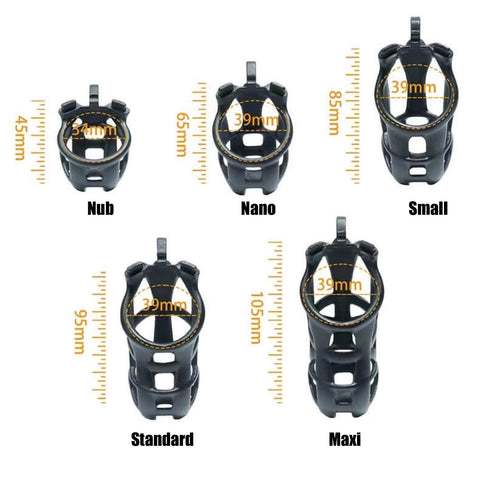
Question: Does the Nub's 34mm annotation describe the same direction as its 45mm annotation?
Answer: No. The 34mm marking runs across the opening in the pictured view; the 45mm scale is positioned along its length. Copying 34mm into a length column would change the dimension being recorded. The image also contains other named bodies, so neither number should be borrowed from an adjacent Nano or Small view.
The Upgraded Cobra Nub Chastity Cage Kit – Black page supplies this shared chart and separately states a 45mm cage length. Use the Nub portion when reading that specific listing. The diagram is useful for identifying annotation direction, but it does not make every dimension on the page an explicit internal measurement. Use the named-size mapping when the same nickname appears on different listings.
Exercise 2: Is the large white arrow a measurement?

Question: Can the large white pointer be read as the span of the 50mm dimension?
Answer: No. It links the circular detail view to the cage. The 50mm annotation sits on the separate scale above the side view, with its own vertical endpoint guides. The front inset's 32mm marking and the ring labels below belong to still other features. One page can therefore contain several legitimate numbers without making them alternatives for the same length.
The Micro Cobra Chastity Cage Kit – 1.97 Inches is the source of this multi-view diagram. Its text distinguishes a 50mm tube length from a 60mm total length. The large white pointer supplies no extra numerical value and should not be used to calculate the difference between those written specifications.
Exercise 3: Does a ring annotation describe the cage?

Question: Can the 42mm marking supply the cage width for a kit using a similar-looking ring?
Answer: No. The marking belongs to a ring opening, and no cage body is pictured. It does not identify the smaller upper connection dimensions either. Assign the value to the depicted ring, without transferring it to another component or an unverified compatible kit.
Separate the cage from the full assembly
Check which components are actually included in the measured view. A ring shown elsewhere on the same canvas does not automatically fall within a cage's length scale. Conversely, an assembled photograph does not prove that a nearby number includes every projecting component. The numerical definition must come from the dimension annotation and the listing text together; the guide to assembled measurement boundaries takes that question further.
Make a side-by-side measurement key
| Exercise | Record | Do not record |
|---|---|---|
| 1 | Nub: 45mm length annotation; 34mm across the pictured opening | 34mm as the length |
| 2 | 50mm belongs to the top scale; white arrow links a detail view | A length measured along the white arrow |
| 3 | 42mm belongs to a depicted ring opening | 42mm as a cage or connector measurement |
Keep the selected model attached to every chart row
If you are considering the black Nub kit, use the Nub annotations even when the shared chart also shows other cage names. If your requirement instead points to another named model, locate that model’s own purchasable listing; a neighboring drawing does not change what the current page sells.
For the Micro kit, keep the body scale separate from the inset pointer and ring labels when preparing your shortlist. Proceed only when the dimensions that matter to your decision belong to the exact product being ordered. If you cannot identify which arrow supplies a required value, ask for clarification before choosing a package; extra rings do not repair an unresolved cage measurement.
For each new diagram, write one line: product, component, view, label and endpoints. The existing measurement guide addresses the wider measurement process. When examining candidates in the 3D printed cage collection, this small reading key helps keep each number attached to the feature it actually describes.


