


Internal vs External Cage Length: Two Product Pages Worked Through
The Micro Cobra listing records a 50mm tube length and a 60mm total length. The Upgraded Nub listing records a 45mm cage length. Those three numbers do not describe three interchangeable measurements. Before comparing them, keep the label attached to each number and examine the endpoints in its own diagram.
This worked example shows what you can calculate, what you can compare, and where the source stops short of identifying internal space. It is about reading product information, not selecting a personal fit or repeating a body-measurement routine.
Locate the start and end points
An internal length describes a span inside the cage. An external length describes an outside span. “Total length” can only be interpreted correctly when the listing makes clear which parts the measurement includes. The start might be a body edge, a connector extremity or an assembled ring position; those are different reference points. The measurement-boundary record examines whether installed hardware is included.
Follow both ends of the dimension line; the diagram-reading exercises distinguish measurement lines from other arrows. Do not read only the number beside it. Then check the accompanying wording for qualifiers such as “tube,” “internal” or “total.” If the diagram and text do not define the span together, preserve the original label in your notes instead of upgrading it to a more precise claim.
Two lengths drawn on the same diagram

The green arrow stops at the inside surface. The blue arrow continues to the outside surface. Neither arrow includes a base ring or connector because neither is drawn. A product's “total length” could use another definition, so this illustration cannot be used to convert a listing's external value into an internal one.
Nor is there a universal amount to subtract. A measured difference can include more than a front wall, depending on the reference points. Without a documented internal span, arithmetic alone does not reveal usable internal space.
Compare internal space with overall length: two real pages
Example A: Micro Cobra's 50mm tube and 60mm total

The Micro Cobra Chastity Cage Kit – 1.97 Inches is useful because its specification separates “50mm (1.97 inches tube)” from “total length 60mm.” The photo also contains a 50mm scale. Keep those two named values separate; the listing does not turn the word “tube” into an explicit internal-length definition.
Here is the complete calculation: 60mm − 50mm = 10mm. The result is the difference between the listing's total-length and tube-length values. It is not a verified wall thickness, connector length or amount of internal room. Writing “10mm difference; endpoints need confirmation” preserves the useful arithmetic without inventing an explanation.
Example B: Upgraded Nub's 45mm cage length
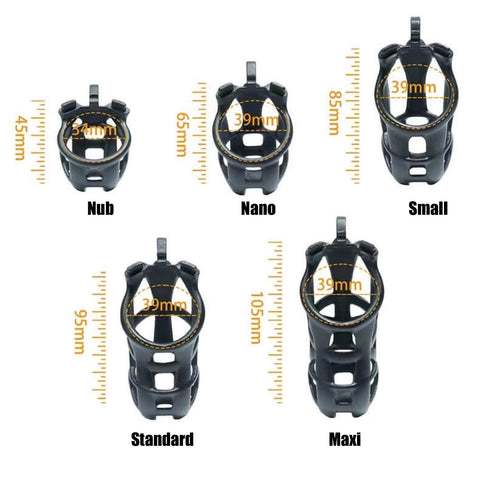
The Upgraded Cobra Nub Chastity Cage Kit – Black records “[Nub] Cage Length: 45mm (1.77 inches).” Its shared diagram places 45mm beside Nub. That is a sourced cage-length value, but the text does not call it an internal measurement or separately provide a total-length value for this comparison.
Subtracting 45 from Micro's 50 gives 5mm numerically. The labels are still different: “cage length” on one page and “tube” on the other. Calling that result “5mm less usable space” would skip the missing endpoint definition. Similarly, comparing Nub's 45 directly with Micro's 60 would mix an unqualified cage measurement with a stated total length.
Match two listings using the same definition
| Field | Micro page | Upgraded Nub page |
|---|---|---|
| Exact length wording | 50mm tube; total length 60mm | Cage Length: 45mm |
| Diagram check | 50mm scale over a side view | 45mm beside the Nub view |
| Explicit internal-length value | Not identified as internal | Not identified as internal |
| Arithmetic supported | 60 − 50 = 10mm between its two stated values | No paired total value used here |
| Remaining comparison question | Do both quoted cage/tube lengths use the same start and end points, and what are the internal-length values? | |
Once the endpoints are confirmed, compare like with like: internal with internal, or the same defined external span with the same external span. When the reference is equipment you already own, the existing-cage measurement record keeps that object and its configuration attached to your reading. Keep the product link and original dimension image beside the answer so a later wording change does not erase the basis for your comparison.
Choose a comparison pair before choosing a length
If you are replacing a cage because of a particular internal-length requirement, neither of these labels alone closes that decision. Keep the Micro kit and black Nub kit as separate candidates until the relevant internal endpoints are confirmed. Do not place the order by choosing the smaller of the two displayed numbers.
If your requirement concerns a documented external span instead, request that same span for both selected configurations and compare it directly. A candidate can move forward when its measurement answers your actual requirement and its package is understood; a different or undefined span remains a reason to pause that candidate.
The existing measurement guide covers the separate task of recording personal measurements. When browsing the Small Cobra collection, use the worked method above to read each listing; a shared size nickname is not a shared measurement definition.


